







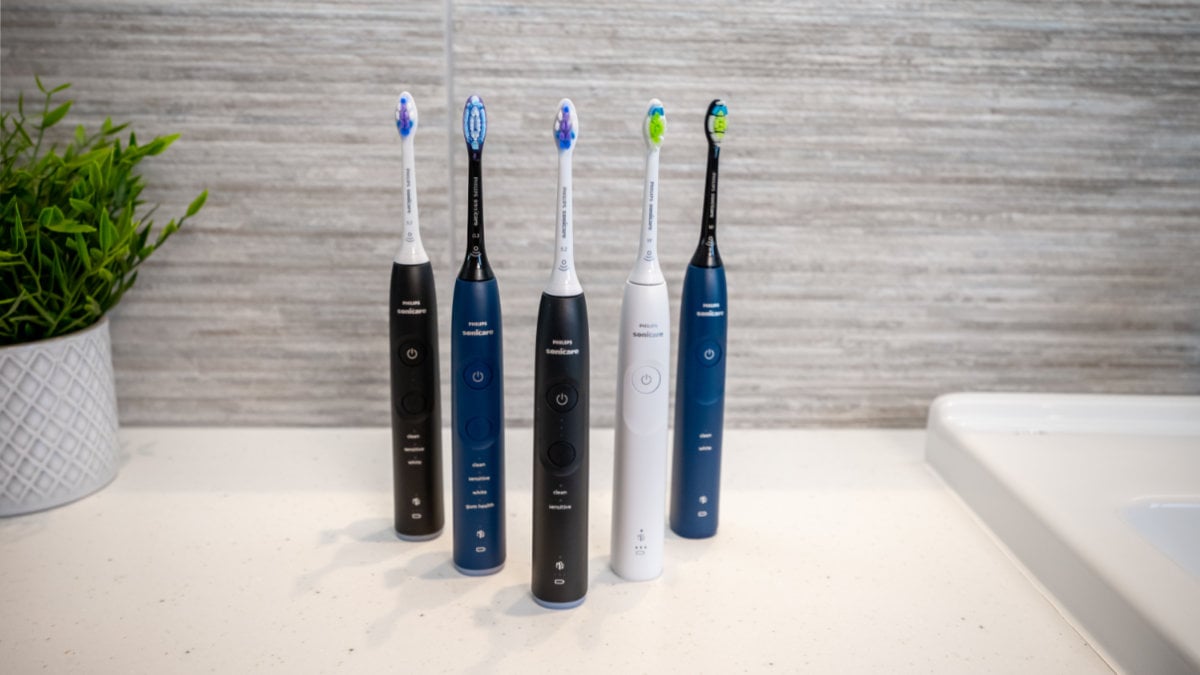
Our verdict
Best overall: Sonicare Series 5300 / Philips, Amazon / ~£55.21
Strong contender: Sonicare Series 5500 / Philips, Amazon / ~£74.99
The 5300 has the core features we recommend for an electric toothbrush: a timer, a pacer and a pressure sensor. They are well implemented. It has great battery life and it feels solid in the hand. It features the same handle design as the other brushes in the range. It has two intensity settings and can be used with a sensitive brush head if you want a gentler cleaning experience than the out-the-box settings. If desired, you can buy it with a basic travel case, or purchase a charging travel case separately.
The 5500 is almost identical, except it has 2 cleaning modes instead of 2 intensities. I explain these differences in more detail below, but in practice it makes little difference. If the 5500 is on offer cheaper than the 5300 then it’s worth going for.


When to choose the 6100, 6500 or 7100
If you suffer from sensitive teeth or gums, or if you like to have more control over the intensity of the brushing sensation, one of these models is worth closer consideration.
With two cleaning modes, each adjustable by three intensities, the 6100 has six overall configurations. You should be able to find an intensity that is comfortable.
The 6500 and 7100 have 9 and 12 configurations respectively.
All three brushes have a visible pressure sensor in addition to a vibrating sensor. If you suffer from sensitivity, a pressure sensor is a good way to ensure you're not brushing too hard and thus worsening that sensitivity.
The 5300 and 5500 also include the vibrating sensor, which is implemented very well and is easy to notice, but the visible pressure sensor is an additional aid that complements this.
Of the three, the 6100 would be my strongest recommendation. It is better value for money compared to the 6500 and 7100.
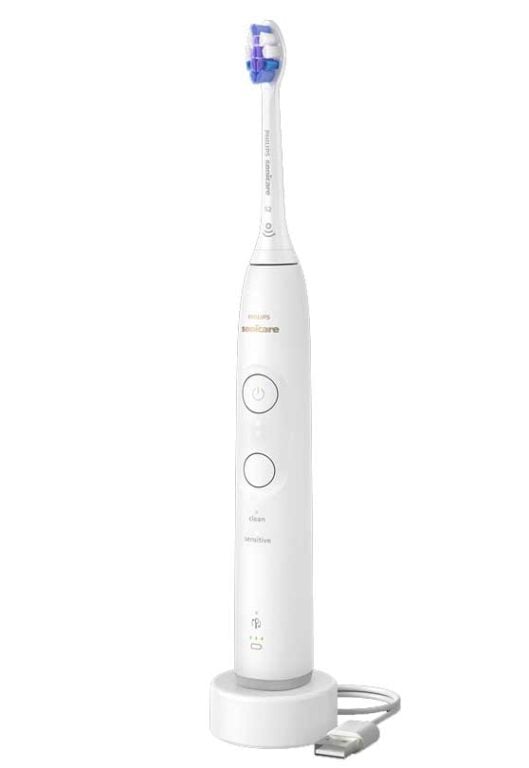
The main reason to consider the 6500 or 7100 would be if you want the Bluetooth features, which I talk about in more detail later on.
In brief, the implementation works well enough but leaves a bit to be desired. Unless you really want the additional feedback on brushing, my advice would be to go for one of the cheaper brushes in the range, or look at a more fully featured smart toothbrush.
How we rated them
All of these brushes are a delight to use. They all clean as well as each other. We've rated them all very highly — the scores range from 82 out of 100 to 86 out of 100. You can see a comparison of our category scores in the table below.
You may be wondering, given the difference in price, how they can all achieve such a high score. The scores reflect the message we've long promoted with electric toothbrushes: you don't need to spend a lot to get a brush that has a strong implementation of the key features.
Used correctly, a brush with such a design is all you need to maintain good oral hygiene. This is therefore the benchmark we use to rate brushes.
The additional technology and features that get added on top of the key features don't do much to move the needle in terms of how well they clean your teeth. They enhance the user experience slightly, but in our minds they often don't warrant spending the extra money. That is, unless you think you'll really make use of and benefit from these features.
| Overall Score |
| How well it cleans |
| How it feels |
| Recommended features |
| Additional items & features |
| Battery performance |
| Smart features |
| Price |
| Buying options |
|
|
|
|
|

|
|---|---|---|---|---|
|
82
|
85
|
85
|
86
|
87
|
|
100
|
100
|
100
|
100
|
100
|
|
88
|
88
|
88
|
88
|
88
|
|
82
|
82
|
82
|
82
|
82
|
|
42
|
62
|
62
|
62
|
71
|
|
80
|
80
|
80
|
80
|
80
|
| - | - | - |
45
|
45
|
|
57
|
43
|
57
|
57
|
43
|
Price
The caveat to the advice above applies if you see one of the brushes higher in the range with a particularly good offer running.
Something that tends to be confusing with a range of brushes such as this is the price. Often there is little difference between the features and price of two models that sit next to each other in the range. For the difference of, say, £10, you may get an extra cleaning mode and a travel case included.
And sometimes you may see a brush that is higher in the range priced cheaper than a brush that's lower in the range. With the features being so similar you could be forgiven for thinking there's something you've missed. Why would a brush with more features be cheaper than a brush with less features?
So, if for example the 7100 is priced cheaper than the 6500 it's because there's a deal running on the 7100, not because the 6500 has some features you haven't noticed. With this new Sonicare range the usual rule of thumb does apply: the higher the model number the more features it has.
They all clean very well
Something Sonicare has promoted as part of this new 2024 range is its new motor technology. The idea is that it stops the motor from slowing if you squeeze the brush into a tight space, such as between your cheek and your molars. It wasn’t particularly noticeable during my testing, but perhaps it shouldn’t be if it’s simply ensuring the power delivery remains consistent.
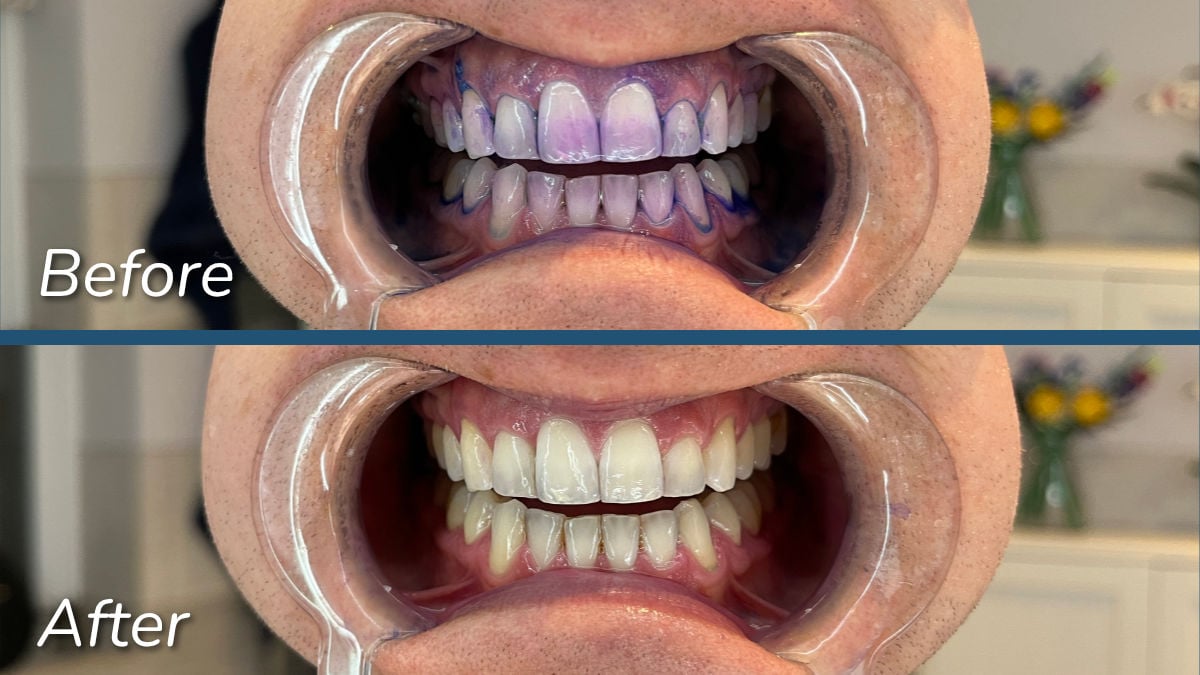
The configuration of the motor is the same across all brushes, delivering a maximum of 31,000 strokes / 62,000 movements. The brushes all cleaned my teeth very well, as demonstrated by the plaque testing results from my reviews. You can see the disclosing test from the 5300 review below. There are only miniscule amounts of plaque left over, which is excellent. All five brushes scored full marks in our cleaning performance category.
Features comparison
Before I go into more detail about the range varies, here's another table comparing the key features.
| Find out more |
| Electric Teeth Rating |
| Number of cleaning modes |
| Brushing intensities |
| Timer |
| Pacer |
| Pressure Sensor |
| Hands-on battery life |
| Number of heads included |
| Travel case included |
| Charging travel case |
| Bluetooth connectivity |
| Noise |
| Overall Score |
| Buying options |
|
|
|
|
|
|
|---|---|---|---|---|
| Review | Review | Review | Review | Review |

(4.8)
|
(5)
|
(5)
|
(5)
|
(5)
|
| 1 | 2 | 2 | 3 | 4 |
| 2 | - | 3 | 3 | 3 |

|
|
|
|
|
| 20 second sextants | 20 second sextants | 20 second sextants | 20 second sextants | 20 second sextants |
|
|
|
|
|
|
| 46 days | 51 days | 48 days | 42 days | 41 days |
| 1 | 1 | 1 | 2 | 2 |
| - | - | - |
|
|
| - | - | - | - |
|
| - | - | - |
|
|
| 63dB | 63dB | 63dB | 63dB | 65dB |
|
82
|
85
|
85
|
86
|
87
|
How they’re similar
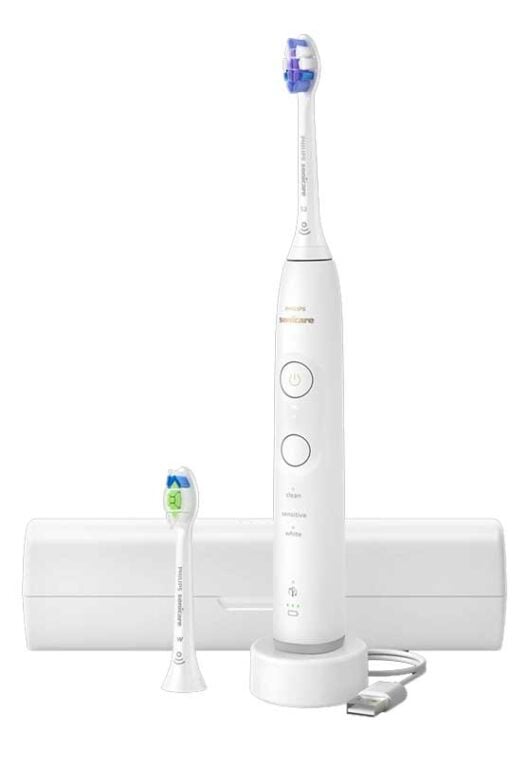
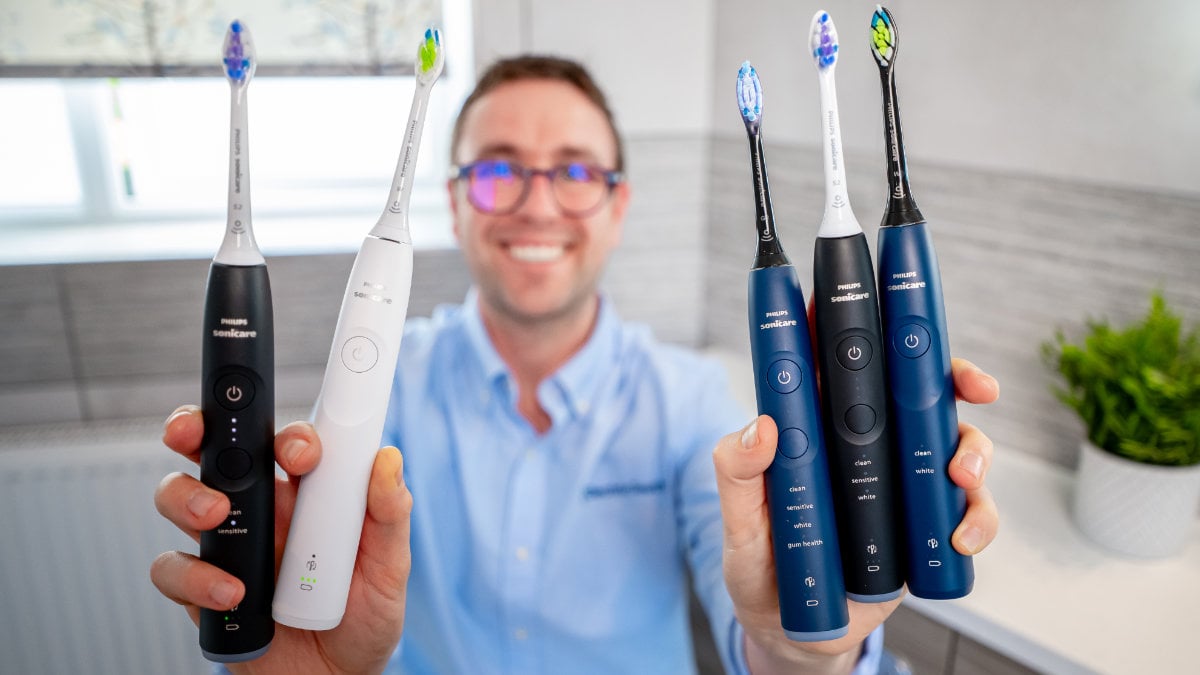
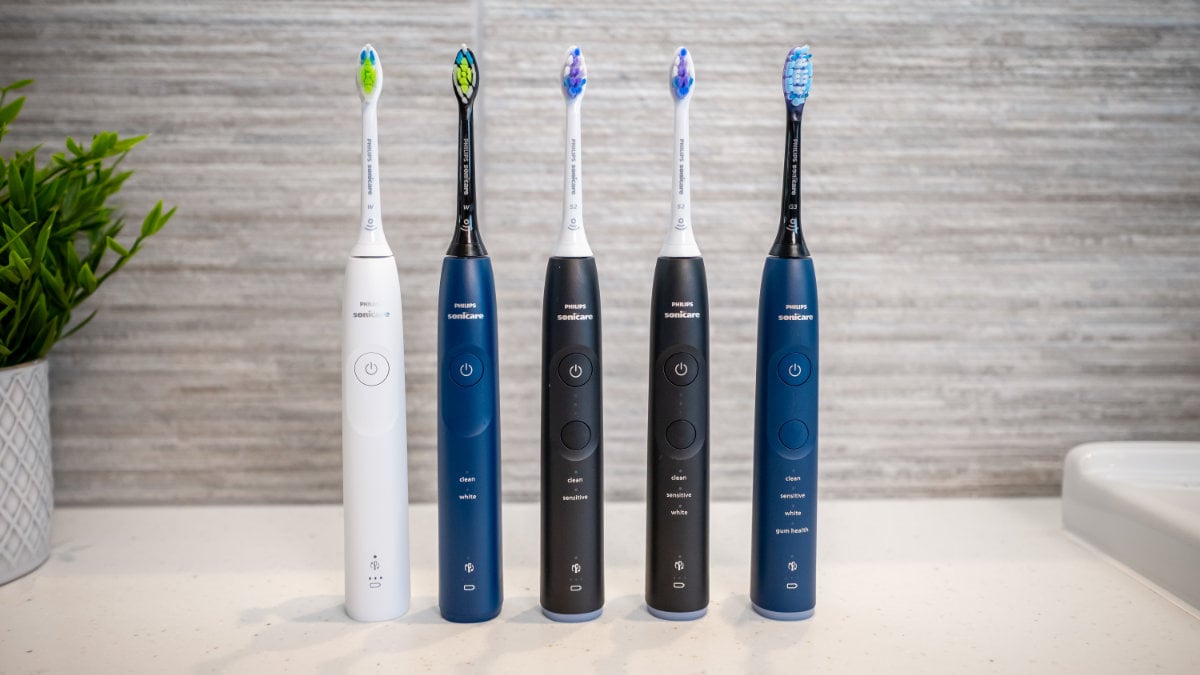
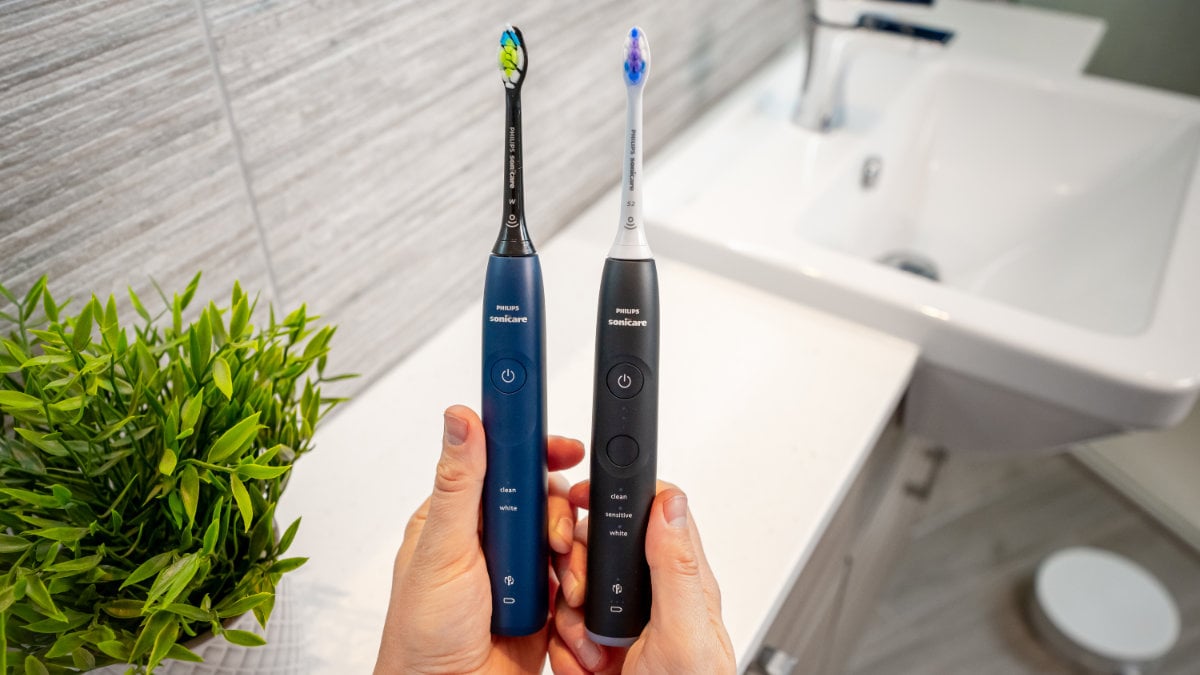
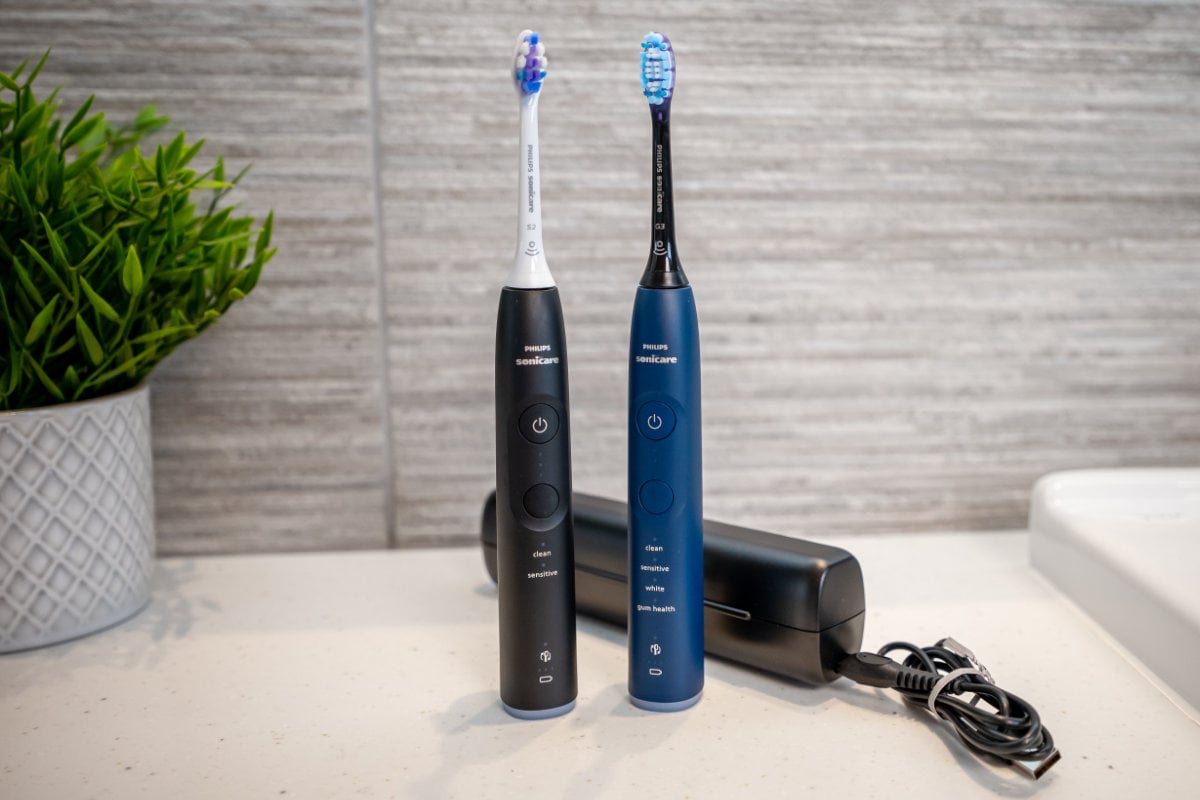
The look and feel of these brushes is the same across the range. They weigh the same, look the same and they've got the same dimensions. There are slight variations in the handle layouts; some have an extra button and LED icons, but this doesn't affect how they feel in hand. They all have a concave recess that houses the button(s).
All of them have superb battery life. Interestingly, despite having the same battery capacity, in my testing some lasted longer than others. The lowest battery life was 41 days (which is still excellent), the highest was 51 days. Sonicare states the battery life for all of them at 21 days, but it came in a lot higher for all models in my real-world testing.
They all have Sonicare’s new brushing technology, which stops the motor from slowing when confined to tight spaces in the mouth — not that I found it particular noticeable during my testing. All of the brush motors make use of 31,000 strokes / 62,000 movements.
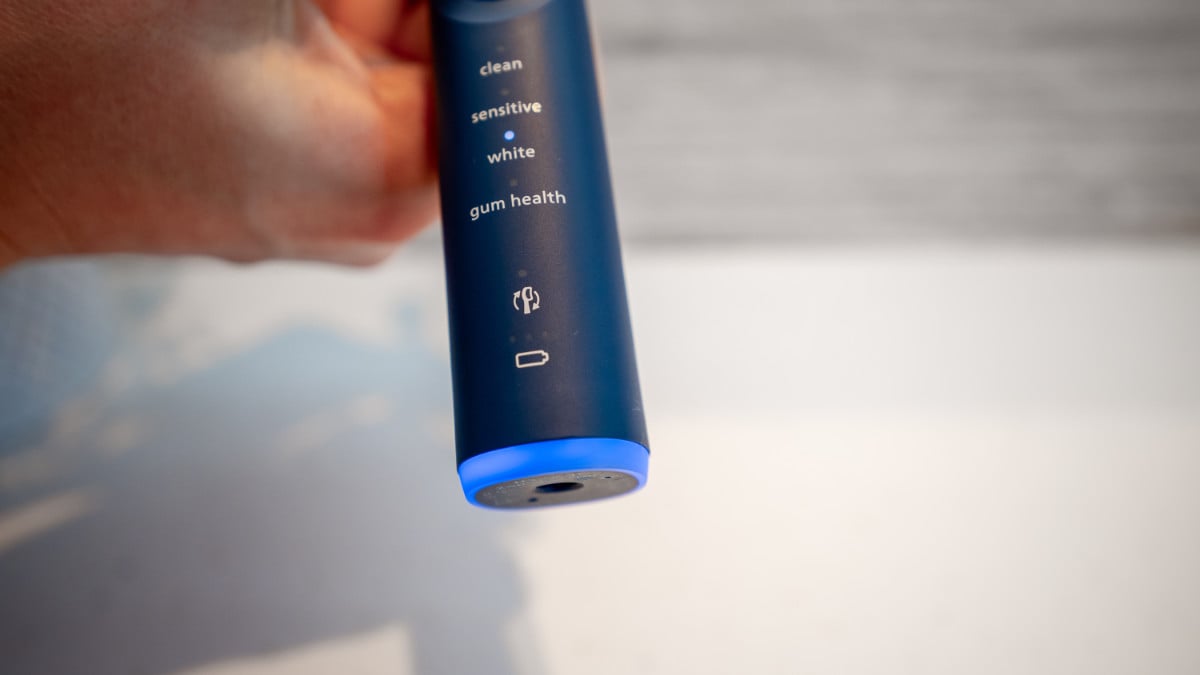
I was impressed by the vibrating pressure sensor implementation, which sends an alert through the handle when activated. This is the same on all brushes. You can also hear the sound of the motor change. The 6100, 6500 and 7100 also have a light ring at the bottom of the handle that illuminates to give you a visual alert.
All of the brushes are compatible with Sonicare’s range of brush heads. The box contents differs between models and some include different brush heads to others, but you are free to buy your preferred brush heads separately. During my testing, the 7100 was the only brush that I noticed working with pairing mode, which means it automatically sets the cleaning mode based on the type of head you attach. It's possible some of the others do, but it's not clear from the documentation and I didn't notice it activate for them.
How they differ (at a glance)
The point to reiterate here is that despite the differences they all did a very good job of cleaning my teeth. I have included more detailed sections for each of the points below, but at a glance here are the key differences.
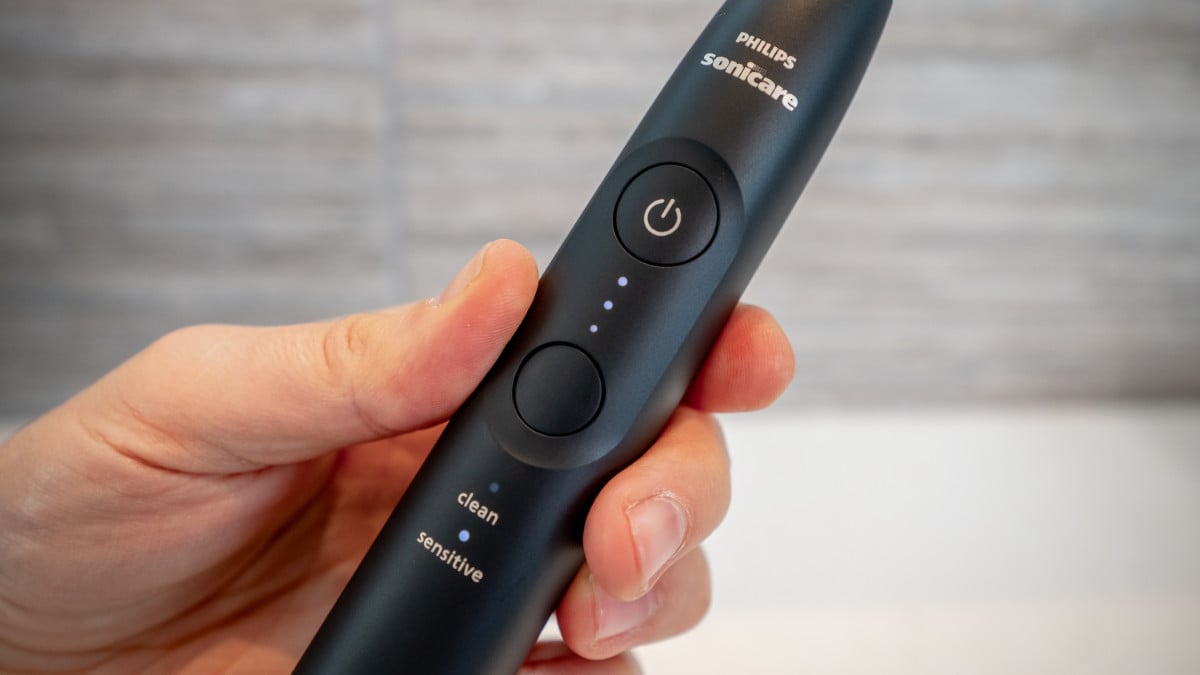
- Cleaning intensities / modes: the 5300 simply has two intensities — high and low. The 5500 has two cleaning modes, but no intensity settings. The 6100, 6500 and 7100 have a mixture of cleaning modes and intensities.
- Buttons: All brushes have a physical on / off button. On the 5300 and 5500 this doubles up as the button for switching intensities and cleaning modes respectively. The 6100, 6500 and 7100 have an additional button dedicated to switching cleaning modes.
- Pressure sensor: All brushes have a vibration alert that travels through the handle when you brush too hard. You can also hear the speed of the motor change. The 6100, 6500 and 7100 have a light ring at the bottom of the handle that illuminates to give you a visual alert.
- Travel case: Some buying options come with a basic travel case that simply protects the brush, others come with a charging travel case. The charging travel case is available to purchase separately should you want to buy it at a later date.
- Bluetooth / smart features: All brushes are compatible with Sonicare’s brush head replacement technology, BrushSync. Only the 6500 and 7100 feature Bluetooth and connect to an app. It does not provide real-time feedback on brushing, though, like some smart toothbrushes. During my testing I noticed the 7100 works with brush head pairing mode.
How they differ (in detail)
Cleaning modes vs intensities
A cleaning mode is a specific configuration of the duration and intensity with which the bristles move to perform the described action. We cover these in more detail in our post on Sonicare cleaning modes, but one example is whitening mode, which I’ll explain shortly. The intensity is the rate at which the bristles vibrate, and when this option is included, there are usually 2 or 3 settings.
This is an area where electric toothbrushes have perhaps becomes more complicated than necessary. Typically I find having a standard mode and a sensitive mode, or a high and low intensity, is sufficient. Even just having a single mode or intensity can be enough. In this scenario, you can make use of a sensitive brush head should you find the mode included is too intense.
Given this, the 5300, which has two brushing intensities, is satisfactory. The 5500 has two cleaning modes, but one of those is Whitening, which I don’t find to be particularly useful compared to having a lower intensity mode / setting.
Whitening mode uses the standard clean settings for 2 minutes, then increases the power for a further 30 seconds at the end to, supposedly, remove stains from the tooth surfaces. You can achieve similar with two intensities: use the standard mode for 2 minutes, then when the brush powers off, turn it back on and use the higher intensity mode to ‘polish’ your tooth surfaces.
Truthfully, brushing your teeth with an electric toothbrush in standard mode for 2 minutes twice a day should remove most surface stains. It’s not necessary to have a whitening mode for this.
The reason to choose a brush with more modes and / or intensities is if you want granular control over the brushing sensation. The 6100 Series is a straightforward example. It has standard clean and sensitive clean and three intensity settings. This essentially gives you 6 different intensity levels to choose from. If you suffer from sensitivity and want to find just the right setting, this could be worth considering.
The 6500 and 7100 have 3 and 4 cleaning modes, each with 3 different intensities, which means they offer 9 and 12 different configurations respectively. They both have Whitening mode and the 7100 has Gum mode. This is almost too much choice — you don’t need this many modes to keep your teeth clean and your gums healthy.
Gum mode lasts for 3 minutes. The first 2 minutes use the standard clean setting and the final minute uses a gentler intensity for your teeth and gums. In a way it’s a useful reminder for you to brush your gums as part of your routine, but if desired you could achieve something similar using one of the other models in the range.
Buttons
All brushes in the range have a physical power button. This differs from some of Sonicare’s other brushes, such as the Prestige 9900, which has a seamless button design. The power button is used to switch between modes / intensities on the 5300 and 5500.
The 6100, 6500 and 7100 have an additional button for switching between cleaning modes and intensities.
The benefit of a physical button like this is that it’s slightly softer to press compared to a seamless button, which is useful if you suffer from arthritis or dexterity issues. However, there is an obvious gap between the edge of the button and the body of the handle. This makes it a potential site for toothpaste residue to build up and form grime.
The seamless button design on the Prestige 9900 was brought in to address this issue as it had occurred with older Sonicare models. It’s possible Sonicare has found a way to combat this since then. Regardless, it’s best to make sure this part of the brush is well-rinsed after each use.
Pressure sensor
Sonicare has done well with the pressure sensor implementation for this range. We recommend a pressure sensor as a key feature because it’s important to make sure you don’t press too hard when brushing.
It’s easy to tell when the pressure sensor has been activated by the change in motor speed alone. There is also a vibration that travels through the handle. Compared to a visual only alert, this is a much better signal for a deaf or blind person because you can easily feel the strength of the vibration. You can also hear the sound of the motor change.
All five brushes have this vibration alert. The 6100, 6500 and 7100 have a light ring at the bottom of the handle that illuminates to give you a visual alert. It’s a useful addition, but you can get by without it if you’re looking to keep costs down. On the 5300 and 5500 the BrushSync notification LED lights up to give a similar alert, but it’s barely noticeable. If a visual pressure sensor alert is important to you, it’s best not to opt for them.
If for any reason you don't want the pressure alerts they can be turned off for all brushes, which is a nice touch.
Travel case
When you buy the Series 7100 it comes with a travel charging case included. All of the other models have the option of being purchased on their own or with a travel case.
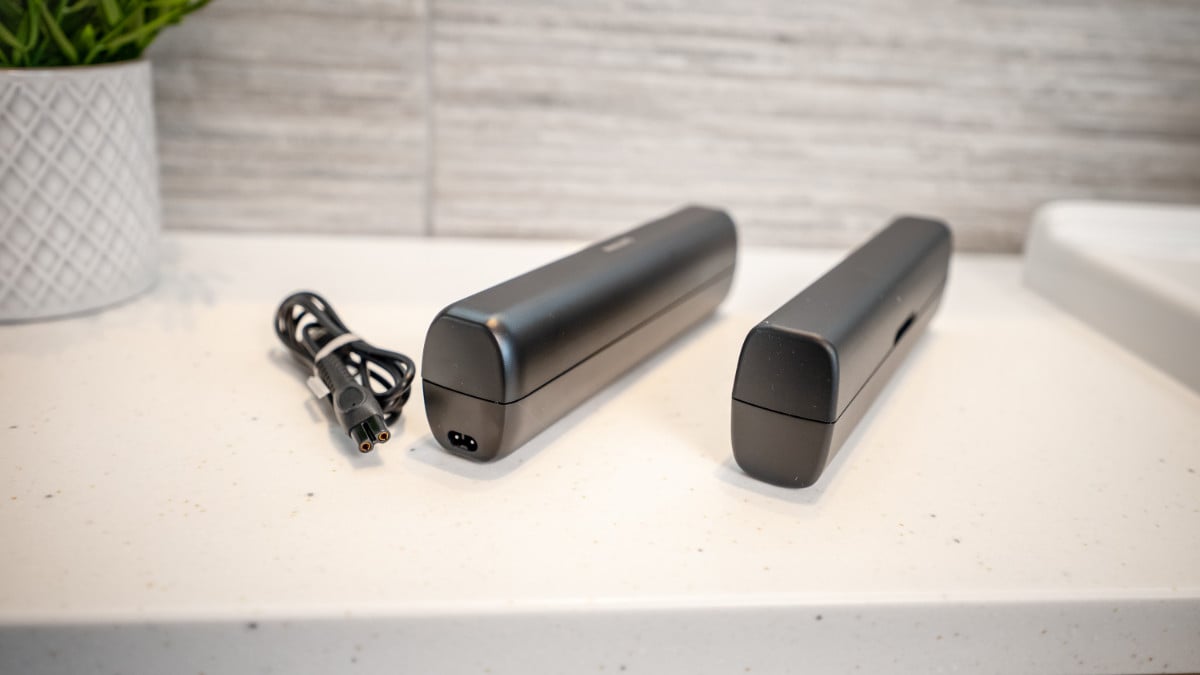
The travel case included with some variants of the 5300, 5500 and 6100 is a basic plastic case. It's a nice slim case that does a good job of protecting the brush when you travel.
If you buy the 6500 with a travel case, it's the charging case that's included. This means that you can charge the brush directly within the case.
It's worth noting that if you buy the 5300, the 5500 or the 6100 on their own, you can buy the charging case separately for around £20. They're all compatible with it.
A charging travel case can be useful, although you may find that given the battery life of these models you don't really need it. Unfortunately it doesn't connect directly to a USB-C charger (the type used for smartphones) like some other charging travel cases do. It has a proprietary cable, so you still need to take an additional cable with you.
For not a lot more inconvenience you could just take the charging stand with you in case you do need to charge whilst away.
Bluetooth & smart features
BrushSync
All five brushes are BrushSync compatible. This means that if you buy BrushSync heads, the BrushSync LED will light up to notify you when it’s time to change brush head. It’s a moderately useful feature, but the heads are more expensive than the standard one, so if you’re trying to save money it’s better to set a calendar reminder to change your head every 3 months.
BrushSync heads also contain an RFID chip, which then creates e-waste when the head is disposed of.
Mode pairing
This is a feature that automatically sets the cleaning mode based on the brush head you attach. If, for instance, you attach a sensitive clean head the brush will switch to sensitive mode. During our initial testing we noticed that the 7100 does have mode pairing. Some of the other models may have it but it’s not clear from the included documentation, and I didn't notice it during testing. It's not a feature worth going out of your way for.
Smartphone app & brushing feedback
The 6500 and 7100 are the only models to have Bluetooth. Considering their price tags, the Bluetooth feature set leaves a little to be desired and isn't what I would call a complete offering.
If you're thinking of splashing out this much on a brush because you want smart features, you may be better off spending a little more and getting the Sonicare Prestige 9900, or the Oral-B iO9 or iO10.
Alternatively, you could consider the Oclean X Pro Elite, which has better smart features and costs less.
The 9900 and the iO9 / iO10 give you real-time feedback, via an app, on how well you're brushing your teeth. Based on user feedback I know people often don't stick to using this technology so I'm reluctant to strongly recommend it unless you really think you will take the time to use it. If you do want it, it works well in these brushes.
With the Sonicare Series 6500 and 7100 you get no such real-time feedback about your brushing. On screen, you only see the timer with six sextants of your mouth. There's no relationship to how well you’re cleaning your teeth. You could move the brush at any angle and it doesn't change what's on screen. It doesn't give you any scoring.
When you consider what the app does overall, it isn't bad. Overall, I score it 7 out of 10 for user experience. It gives you a dashboard of colour-coded information, which is quite useful and probably enough for most people.
The app has got some useful tips and tricks, but it's mainly looking at logging your sessions. It's not giving specific feedback about brushing in certain areas of the mouth. It encourages you based on time and pressure and includes on-screen warnings about using too much pressure.
It doesn’t show what mode or intensity you are using or the battery percentage remaining. Some of these omissions would be easy implementations for Sonicare that would add to the user experience.
Brush vs brush comparisons
In the sections below I have outlined the key similarities and differences between brushes that are near to each other in the range and commented on which I would choose.
We're in the process of creating video comparisons for these, which I'll add the links to once they are available.
You can also compare multiple brushes in detail using our Toothbrush Comparison Tool.
5300 vs 5500
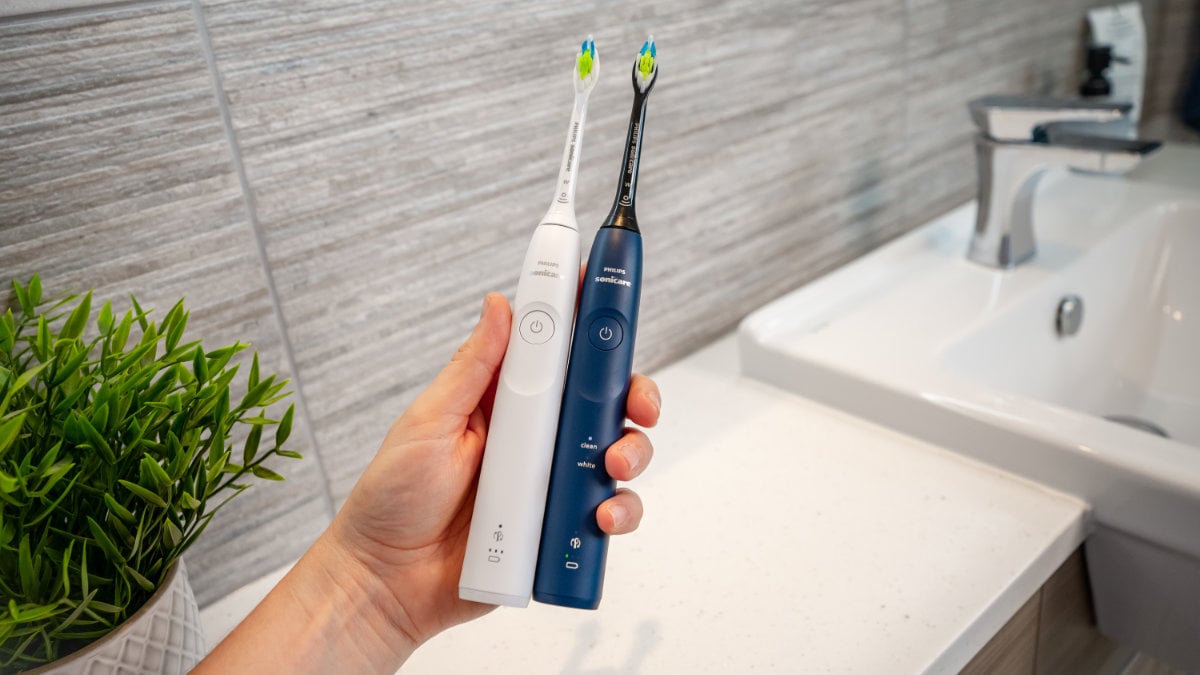
- My overall pick would be whichever is cheapest when you come to buy, or if the 5500 is no more than £5 more than the 5300, I would go for that.
- The RRP for the 5500 is slightly more, but both brushes retail at roughly the same price of £70 to £80.
- Both are available with a travel case for about £10 more.
- The 5300 has two intensities (low and high) whereas the 5500 has two brushing modes (standard clean and sensitive).
- The 5500 has LEDs and labels for its cleaning modes. The 5300 does not have them for its intensities, but it’s easy to tell which you are using.
- The same battery is included with both, but in my testing I achieved 51 days with the 5500 and 46 days with the 5300. Sonicare states the battery life for both at 21 days.
- Other than the above, the brushes are the same and the handles are the same shape, size and weight.
5500 vs 6100
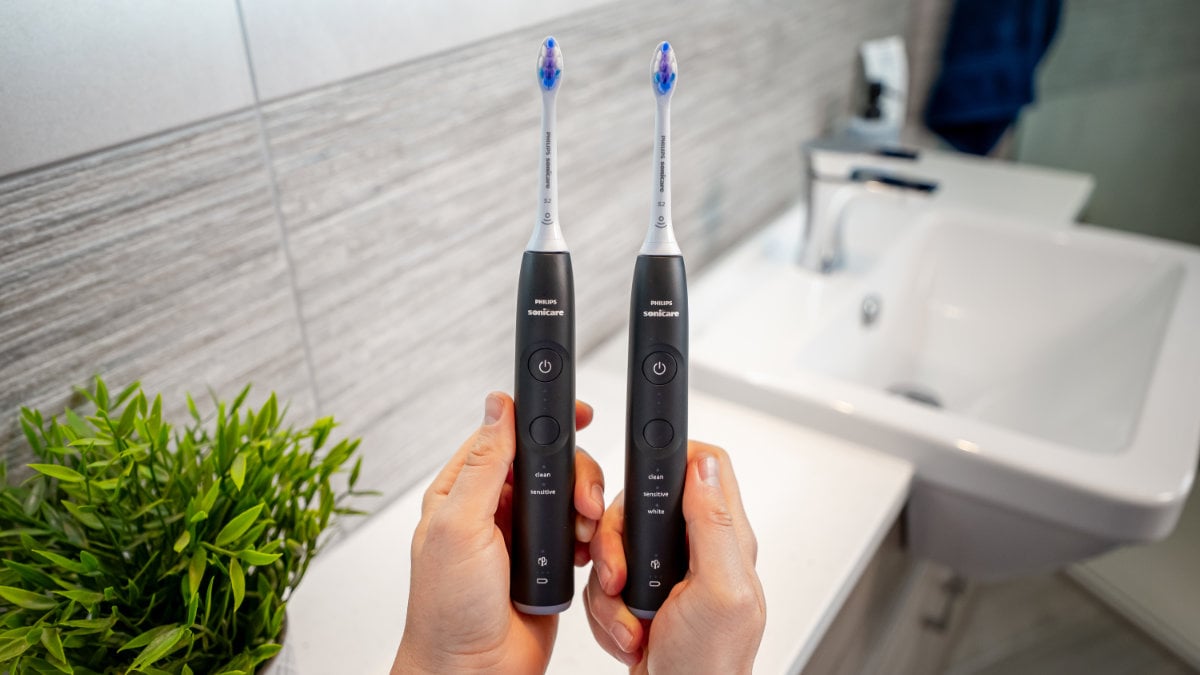
- These are very similar. The main differences are the cleaning modes / intensities included and the pressure sensor.
- Both come with a standard clean mode. The 5500 comes with a whitening mode, whereas the 6100 comes with a sensitive mode.
- The 6100 offers 3 different intensities for each mode. The 5500 does not have different intensities, just two cleaning modes.
- The 6100 has a dedicated button for switching cleaning modes. The 5500 uses its power button for switching modes
- The 6100 comes with a visible pressure sensor, which is useful, but both brushes have a vibration alert that is easy to notice.
- If having a visible pressure sensor is important to you, the 6100 is worth considering if it’s not priced much higher than the 5500. I would say it's worth going for if it's no more than £20 more than the 5500
- Typically the 5500 sells for £70 whereas the 6100 sells for £90.
- In my testing, the 5500 achieved 51 days battery life. The 6100 achieved 48 days. Both are excellent.
5500 vs 6500
- Despite the 6500 being more feature rich, the 5500 is my pick and recommendation. It is better value for money.
- The 5500 is cheaper — it typically sells at £70 compared to £180 for the 6500.
- The 6500 has 3 cleaning modes compared to the 2 of the 5500.
- The 6500 has 3 brushing intensities for each cleaning mode. The 5500 does not have any intensities, just the two cleaning modes.
- The 6500 has a dedicated button for switching cleaning modes.
- The 6500 has a visible pressure sensor and a vibrating pressure sensor, whereas the 5500 only has a vibrating sensor. That being said, the vibration sensor is very easy to notice.
- The 5500 has a better battery life — 51 days compared to 42 days in my testing.
- The 6500 always comes supplied with a travel case.
- The 6500 has Bluetooth connectivity.
- The 6500 is 2 decibels quieter.
6100 vs 6500
- My overall pick is the 6100. The extra cleaning mode (whitening) and Bluetooth features of the 6500 aren’t worth the price increase.
- The typical selling price of the 6100 is around £90, compared to £180 for the 6500.
- Both brushes offer 3 different cleaning intensities for each mode.
- Both have labels for the cleaning mode and intensity selected.
- The 6500 connects to a smartphone app, which provides brushing feedback but does not show real-time tracking as you brush
- Both batteries have 21 days stated usage time from Sonicare, but I achieved 48 days with the 6100 and 42 days with the 6500.
- The 6500 always comes with a travel case. There are options for a charging case or a non-charging case.
- The 6100 has a variant with and without a non-charging travel case.
- The charging case can charge the brush and holds 1 brush head and 1 handle, whereas the non-charging case holds 1 handle and 2 heads.
- Both cases are available to purchase separately if desired, so you could buy the 6100 without a case and then purchase the charging travel case.
6100 vs 7100
- My overall pick is the 6100. It cleans the teeth just as well but costs less.
- The 6100 typically sells for around £90, compared to £140 for the 7100.
- The Series 7100 has four cleaning modes compared to the two of the 6100. Both have standard clean and sensitive, the 7100 has white mode and gum mode.
- The 6100 has better battery life — 48 days compared to 41 days of the 7100 during my testing.
- The 7100 has brush head mode pairing — this matches the type of brush head attached to the most suitable cleaning mode. It’s not a feature worth worrying about too much.
- The 7100 comes with a travel case that allows the brush to be charged whilst inside.
- The 6100 is available without a travel case, or with a non-charging travel case.
- The charging travel case can be purchased separately for the 6100 if desired.
- The 7100 has Bluetooth connectivity.
- The 7100 is louder by 2 decibels.
6500 vs 7100
- My advice here is to go for whichever is cheapest. When the brushes first launched, we noticed the 7100 was cheaper than the 6500, despite being higher in the range.
- The 7100 always comes with a charging travel case. The 6500 has variants with a non-charging case or a charging case.
- The other main difference is that the 7100 has an additional cleaning mode (Gum mode). Both brushes come with standard, white and sensitive modes, and three intensities.
- During testing, I noticed the 7100 has 'mode pairing' for BrushSync heads
- The 6500 was quieter in my testing, measuring 61dB compared to 65dB for the 7100
- The battery life is very good for both and almost the same — 42 days for the 6500 in my testing and 41 days for the 7100.
Conclusion
This range of brushes is a replacement for the popular Sonicare ProtectiveClean series and ExpertClean series.
Those brushes were also very good, which has made this update iterative rather revolutionary. Nonetheless, the result is a strong offering of brushes that are nice to use and clean your teeth well.
Unusually, this range doesn't have a collection name like its predecessors. It seems Sonicare is differing the names of these brushes by using 'Series' at the beginning, e.g Sonicare Series 5300, as opposed to at the end of the name, such as Sonicare 4100 Series, which was used on some of its more recently released models.
My recommended choices are the 5300 or 5500. The 6100 is also worth strong consideration if you would like a visible pressure sensor or a bit more control when it comes to cleaning modes and intensity.
The 6500 and 7100 are still fantastic brushes, but the Bluetooth functionality pushes the price tag up without enhancing the user experience that much, in my opinion.
Whichever you choose, you'll be getting a strong implementation of the key electric toothbrushes features, excellent battery life and a slick design.


Surprisingly I noticed with my new Sonicare 5500 that it has brush head pairing mode.
How do you get battery to last so long?
Mine doesn’t last 40 days
Different brushing modes, brushing times and frequency of use can impact battery life. We have a standard test we run on all brushes for consistency.
In the comparison between the 5300 and the 5500 you mention that (regarding the 5500): "Whitening mode uses the standard clean settings for 2 minutes, then increases the power for a further 30 seconds at the end"
Does this mean that the 5500's whitening mode is almost exactly the same as the standard one, but that it has some sort of "Power-Boost" for the last 30 seconds and during those 30 seconds it is stronger than the 5300's standard mode?
Hi Conrad.
Yes, kind of. It changes the brush motion/power slightly. Exaclty how, Philips will not reveal. It gives a slightly different cleaning action, feel and sound.